From Faulty Samples to $200k: How One Collegiate Brand Stopped Firefighting and Started Growing
What happens when manufacturing stops being the bottleneck

Elishah Williams (@runonrebel) came to us stressed, behind on orders, and stuck. Seven months later, he gifted the Governor of Virginia one of his polos. Here's what actually happened.
If you're running a collegiate or Greek apparel brand in your first two years, you know the feeling. You've got the vision. You've got the relationships on campus. But somewhere between "yes, we want 200 hoodies" and delivery day, something always goes wrong.
Bad stitching. A sample that took 6 weeks to arrive and still wasn't right. A manufacturer who goes quiet three days before a chapter event. You're not growing the brand — you're just managing damage.
That's exactly where Elijah was when he first reached out to us.
The situation
Elisha Williams runs Overtime Creations, a collegiate apparel brand serving university chapters and Greek organizations. When he came to us, he wasn't new to the business — but he was stuck. Quality issues were eating into his margins. Long lead times were killing deals. He was losing sleep over orders he'd already committed to.
He found us through a referral from an existing client. No ad, no cold DM. Just one brand owner telling another: these people actually deliver.
Month 1: Getting the sample right
We started where we always start — with a sample. Not a rushed one. A real one, built around the exact spec Elisha needed.
His first order was a double-sided print with a precise zipper alignment and symmetry requirement. It took several attempts. We don't rush samples to get to the invoice. We get it right, then we scale.
What happened next is worth noting: Elisha sent us a message after receiving the zip-ups. He said customers loved them and were already asking for 30 more. His exact words — "this is what I was talking about, if we make orders like this we get more orders."
He understood immediately what good manufacturing does for a brand: it compounds.
Month 2: The biggest order in his brand's history
Six weeks after that first sample, Elisha closed a 600-unit custom zip-up order for Hampton University's graduating batch — worth over $30,000. The biggest deal he'd ever done.
This wasn't a simple order. It required:
DesignUniversity approval and compliance with Hampton's brand standardsTechniqueDistressed denim appliqué — a specialized finish most manufacturers won't touchAdminFull invoicing support to help Elisha handle the paperwork at this scaleLogistics700kg shipment, special truck booked from New York airport after arrivalDeadlineDelivered 3 days early — by April 5th, well ahead of schedule
Total production time: 23 days.
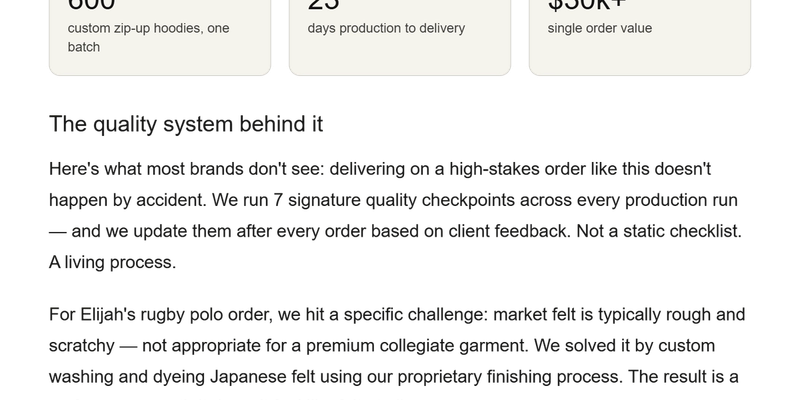
600custom zip-up hoodies, one batch23days production to delivery$30k+single order value
The quality system behind it
Here's what most brands don't see: delivering on a high-stakes order like this doesn't happen by accident. We run 7 signature quality checkpoints across every production run — and we update them after every order based on client feedback. Not a static checklist. A living process.
For Elisha's rugby polo order, we hit a specific challenge: market felt is typically rough and scratchy — not appropriate for a premium collegiate garment. We solved it by custom washing and dyeing Japanese felt using our proprietary finishing process. The result is a surface so smooth it doesn't feel like felt at all.
This is the kind of problem-solving that doesn't show up in a spec sheet. It lives in the experience of doing this across hundreds of orders.
What trust actually unlocks
By the time Elisha had worked with us for a few months, something shifted operationally. He no longer needed to receive a physical sample before approving a chapter order.
That might sound small. It isn't.
When a chapter places a custom order, the traditional workflow is: spec → sample shipped → approval → production. That process can add 2–3 weeks to every single order. With Elisha , we'd built enough mutual understanding that he could approve remotely — cutting total turnaround to under 20 days for custom chapter orders, consistently.
That speed became a competitive advantage on campus. Chapters knew he delivered fast and right. Referrals followed.
Months 3–7: What happens when manufacturing stops being the bottleneck
Month 3: Elisha secured university licensing with Hampton University — a milestone that opens doors to official chapter business Month 4: Orders came in from Hampton's African club, the university recruiting team, and admissions staff — over 300 units across multiple product types. Word had spread: he made the best clothing on campus. Month 5: Elijah took his family on a Caribbean vacation. That's what operational stability actually looks like.
Month 6:At Hampton's homecoming, he set up a brand stall and personally gifted a polo — made by us — to Virginia Governor Abigail Spanberger. Month 7:Approved as a licensed vendor for Omega Psi Phi, one of the most established fraternities in the country.
In total, we've produced over 2,000 units for Overtime Creations across a range of product types, decoration techniques, and university requirements. His revenue has crossed $200,000. His story is still going.
"When quality in manufacturing becomes a limiting factor, growth stops. Sometimes brands have to cease operations."
We've seen this happen. We've also seen what the opposite looks like — and that's Elijah. When the production side is handled, founders stop firefighting and start building: expanding their network, adding campus managers, turning happy customers into referrals.
If this sounds like where you are
We work with Greek and collegiate brands who are stuck — specifically those struggling with quality consistency, long lead times, or a manufacturer that simply doesn't understand the stakes of campus and chapter deadlines.
We're not asking you to switch manufacturers or make any commitment. We're offering a free sample, made to your spec. You decide what happens next.
Six brands in the past year have started exactly this way. Most are now focused on growing, not managing production problems.